CI Integration
Hosanna provides CI-safe commands, but it does not impose one universal pipeline file. Start from the application’s package.json, hosanna.json, engine requirement, and target projects. Run platform packaging only on workers that have the relevant SDK and signing access.
Recommended Stages
- Install: use the repository’s required Node version and
npm ci. - Authorize: provide
HSC_LICENSE_KEYthrough a protected environment variable. - Install sources: run
npx hst license:status,npx hst sdk:install, andnpx hst compiler:install. - Restore CI secrets: run
npx hst build-config:restore-secretsonly in jobs that need those overlays. - Validate: generate source, type-check, lint, and run unit/integration tests through project scripts.
- Build: use explicit platform, environment, target, app profile, and
--non-interactive. - Package and sign: isolate credentials by platform and release lane.
- Archive: retain the artifact, test report, source revision, resolved-source manifest, and checksums.
Example setup:
npm ci
npx hst license:status
npx hst sdk:install
npx hst compiler:install
npx hst build-config:restore-secrets --env prod --quiet

npm run generate
npm run lint
npm test
Use the exact scripts present in the app; do not copy a sample command that its package.json does not define.
Build Jobs
Keep the target explicit and fail instead of prompting:
# Use the host application's production Vite script for Browser output.
npm run build:browser

npx hst build tizen prod device \
  --signing-profile samsung-tv-prod \
  --non-interactive

npx hst build webos prod device --non-interactive

npx hst build roku prod device \
  --hsc-project platforms/hsconfig-roku.prod.json \
  --non-interactive

npx hst build apple-tv prod device \
  --bundled \
  --non-interactive

npx hst build android-tv prod device \
  --bundled \
  --non-interactive
For app flavors, add --app <key> consistently to config resolution, build, tests, and packaging.
Secrets and Trust Boundaries
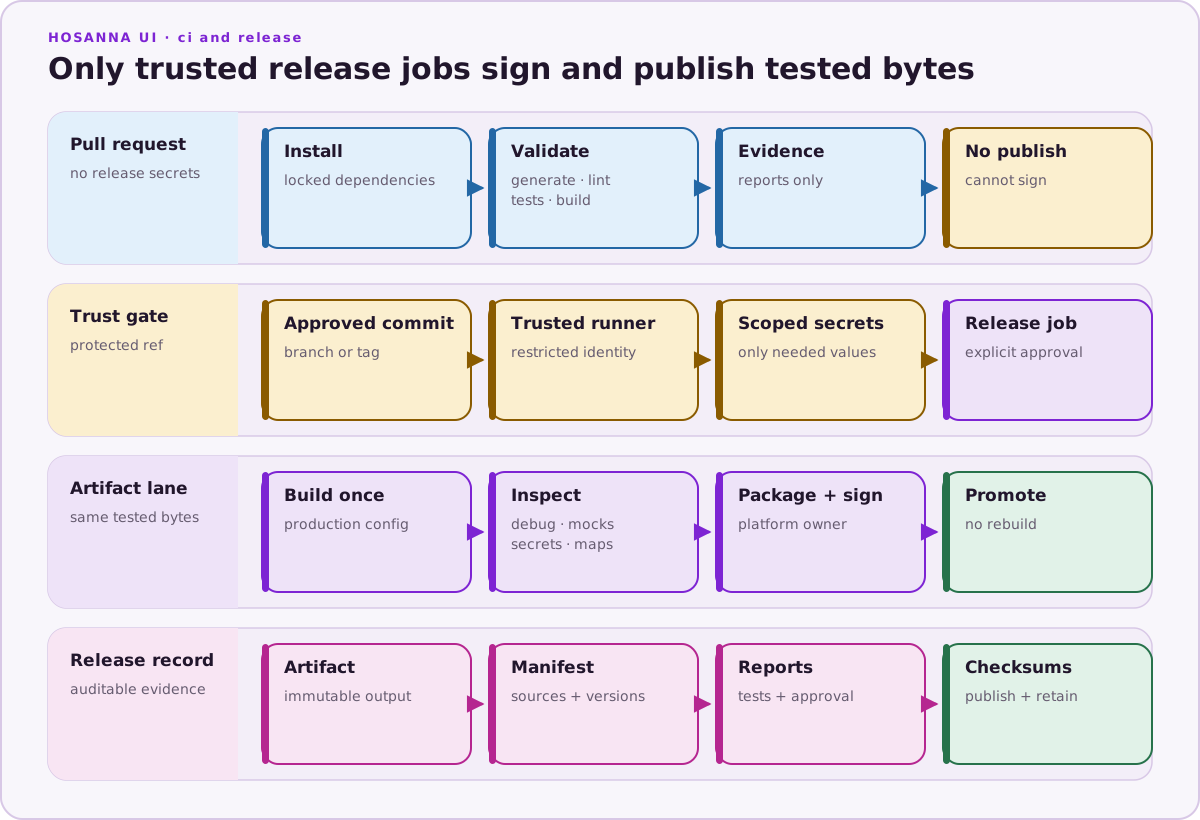
- Store
HSC_LICENSE_KEY, signing keys, provisioning credentials, store tokens, Roku passwords, and base64 overlays in protected CI variables. - Restrict signing jobs to protected branches/tags and trusted workers.
- Do not expose secrets in command arguments when an environment variable is supported.
- Do not cache restored
secrets/, native signing state, or resolved secret-bearing config in a shared cache. - Review pull-request pipelines so untrusted code cannot print protected variables or upload forged artifacts.
build-config:restore-secrets accepts:
BUILD_CONFIG_SECRETS_<ENV>_BASE64
BUILD_CONFIG_PROFILE_SECRETS_<PROFILE>_BASE64
The variables decode to ignored JSON overlays. Keep normal endpoints and non-confidential behavior in tracked build-config/ so a release remains reviewable.
Tests and Device Labs
Run fast browser regression suites on ordinary workers. Run native simulator suites on macOS/Android workers with the corresponding SDKs. Reserve physical-device and signing jobs for controlled runners.
The current sample repository exposes browser and native simulator scripts such as:
npm run test:ui:web
npm run test:ui:ios:sim
npm run test:ui:android:sim
npm run test:ui:androidtv:sim
Physical Roku runs require a reachable device and should not share a sideload target between concurrent jobs.
Tizen and webOS package jobs require the vendor CLI on the worker, but
hst build ... device does not discover or contact a TV. Keep the Samsung
certificate profile on a protected signing worker. LG Developer Mode keys are
needed only for device install/run jobs, not for .ipk creation. Run the
physical-TV suites only on controlled runners with an already trusted device,
a LAN-reachable debugger/test-stream host, and explicitly configured external
capture when video evidence is required. Retain their reports and captures as
application release evidence for the tested model matrix.
Reproducibility Checklist
- Pin dependencies with the lockfile and use
npm ci. - Let
hosanna.jsonpin the SDK/compiler distribution expected by the app. - Record HST, SDK, compiler, Node, platform SDK, and runner versions.
- Generate timestamps and Git metadata once per release, before the build matrix fans out.
- Build each artifact once; promote the tested bytes.
- Publish checksums and retain test evidence with the artifact.
- Make retries create a new build number unless the output is proven byte-for-byte identical.